Below we will offer a brief description of the morphological evaluation sheet used by breed experts in order to assess which breeders should be listed in the Herd Book set up by ANABIC headquarters in 1994. This linear assessment system involves measuring certain traits in a quantitative way, assigning a numerical value to each trait, which is considered univocally. This value is placed on a linear scale that goes from one biological extreme to the other.
The variability of a given trait found in the population has been subdivided into five classes (values from I to 5). In the case of measured traits, a module equivalent to 1.5 standard deviations is used for the trait being examined, whereas for non-measurable traits, the morphological limits evaluated by breed experts are used. Based on this preliminary explanation, we can move on to describe the sheet illustrated below.
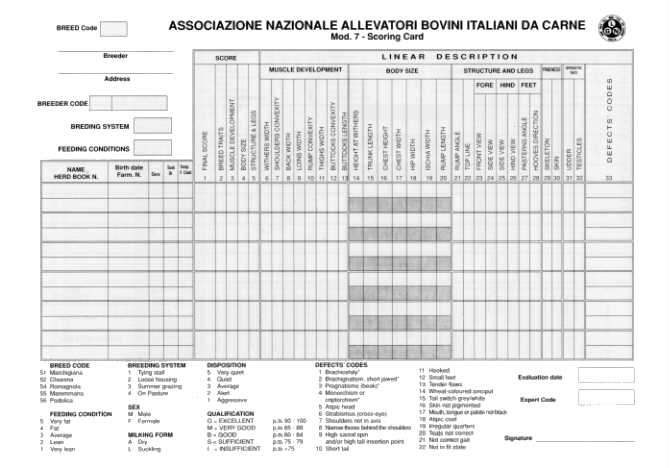
It includes a section related to breeding, a general section on the subject, an overall summary evaluation, a linear description, an indication of any notes or defects, and a section concerning standards.
The following indications are envisioned:
- BREED: identified with a code number (51forMarchigiana, 52 for Chianina, 54 for Romagnola, 55 for Maremanna, 56 for Podolica);
- breeder's name
- location of the cattle farm
- breeding system
-farm feeding conditions
Feeding conditions represents the first item on the sheet to be indicated in a linear fashion: an expert observes the entire group of animals comprising the farm and must place it in the corresponding class, based on the following scale:
Class 1 |
Class 2 |
Class 3 |
Class 4 |
Class 5 |
|
|
|
|
|
Very Lean |
Lean |
Average |
Fat |
Very Fat |
The following data is indicated:
- name and registration number of the Italian Herd Book
- company number
- date of birth
- gender
- lactation condition (A= dry L = suckling)
- temperament indicated according to the following scale;
Class 1 |
Class 2 |
Class 3 |
Class 4 |
Class 5 |
|
|
|
|
|
Aggressive |
Not quiet |
Average |
Quiet |
Very quiet |
-feeding condition of the subject (using the same scale used for the feeding condition of the cattle farm).
This is the most important part since beef cattle must be muscular. Therefore, this must be assessed with extreme care, also taking into considera- tion the fact that we are dealing with traits that are not measurable using precision instruments. Instead, these traits are evaluated directly by the assessor.
In this evaluation, only the muscle development (profiles) of the indicated regions must be assessed.
As stated at the beginning of the article, these values are drawn from a linear scale that divides the variability encountered in the population into 5 classes, as illustrated below:
Class 1 |
Class 2 |
Class 3 |
Class 4 |
Class 5 |
|
|
|
|
|
Very Narrwo (Compact) |
Narrow |
Average |
Wide |
Very Wide |
Class 1 |
Class 2 |
Class 3 |
Class 4 |
Class 5 |
|
|
|
|
|
Flat |
Little muscle covering |
Average Muscularity |
Convex |
Very Convex |
Class 1 |
Class 2 |
Class 3 |
Class 4 |
Class 5 |
|
|
|
|
|
Very Narrow |
Narrow |
Average |
Wide |
Very Wide |
Class 1 |
Class 2 |
Class 3 |
Class 4 |
Class 5 |
|
|
|
|
|
Very narrow |
Narrow |
Average |
Wide |
Very Wide |
Class 1 |
Class 2 |
Class 3 |
Class 4 |
Class 5 |
|
|
|
|
|
Meager |
Little Muscle Covering |
Average Muscularity |
Convex |
Very Convex |
Class 1 |
Class 2 |
Class 3 |
Class 4 |
Class 5 |
|
|
|
|
|
Very Narrow |
Narrow |
Average |
Wide |
Very Wide |
Class 1 |
Class 2 |
Class 3 |
Class 4 |
Class 5 |
|
|
|
|
|
Concave |
Flat |
Average Convexity |
Convex |
Very Convex |
Class 1 |
Class 2 |
Class 3 |
Class 4 |
Class 5 |
|
|
|
|
|
Very Short |
Short |
Average |
Long |
Very Long |
This part of the chart includes a set of items defining the animal's somatic development.
First of all, measurements were made on samples representing the population in order to discover the variability of each trait with regard to each breed and animal category. Subsequently, after analysis and data assessment were performed, five classes were defined to describe the variability encountered in the population.
The assessor must place each examined trait in the corresponding class, initially using technical instruments (measuring rod). Afterwards, with experience, attribu- tion to a specific class will be made through assessment rather than measurement.
Measured as height at withers
|
Class 1 |
Class 2 |
Class 3 |
Class 4 |
Class 5 |
|
|
|
|
|
|
|
To get the linear classes click on the following links:
|
||||
From the tip of the shoulder to the tip of the buttocks
|
Class 1 |
Class 2 |
Class 3 |
Class 4 |
Class 5 |
|
|
|
|
|
|
|
To get the linear classes click on the following links:
|
||||
Given as the vertical distance between the rear area of the withers and the sternum, just behind the elbow.
|
Class 1 |
Class 2 |
Class 3 |
Class 4 |
Class 5 |
|
|
|
|
|
|
|
To get the linear classes click on the following links:
|
||||
Distance between sides at elbow level
|
Class 1 |
Class 2 |
Class 3 |
Class 4 |
Class 5 |
|
|
|
|
|
|
|
To get the linear classes click on the following links:
|
||||
Distance between the outer corners of ilia
|
Class 1 |
Class 2 |
Class 3 |
Class 4 |
Class 5 |
|
|
|
|
|
|
|
To get the linear classes click on the following links:
|
||||
This is the distance between ischial tuberosities
|
Class 1 |
Class 2 |
Class 3 |
Class 4 |
Class 5 |
|
|
|
|
|
|
|
To get the linear classes click on the following links:
|
||||
Measured between the outer corner of the ilium and the top of the buttocks.
|
Class 1 |
Class 2 |
Class 3 |
Class 4 |
Class 5 |
|
|
|
|
|
|
|
To get the linear classes click on the following links:
|
||||
This group of items is aimed towards describing the skeletal structure of the subject and is very significant in terms of the animal's career, especially as far as leg direction is concerned.
This is assessed as the angle of inclination formed by the ilium-ischium annectant with a line drawn parallel to the ground.
Class 1 |
Class 2 |
Class 3 |
Class 4 |
Class 5 |
|
|
|
|
|
Very sloping |
Sloping |
Horizontal |
Higher at pins |
Very Higher at pins |
This evaluates the presence or lack of horizontaly with respect to the lumbodorsal line.
Class 1 |
Class 2 |
Class 3 |
Class 4 |
Class 5 |
|
|
|
|
|
Concave (Deep Hollow) |
Slightly Concave (Hollw) |
Strong and horizontal |
Slightly Convex (Arched) |
Very Convex (Kyphosis) |
This evaluates foreleg perpendicularity as viewed from the front. The vertical line extending from the tip of the shoulder to the ground must divide all leg areas in half.
Class 1 |
Class 2 |
Class 3 |
Class 4 |
Class 5 |
|
|
|
|
|
Twisted very inwarded |
Twisted in |
Perpendicular |
Twisted out |
Twisted very inwarded |
This evaluates foreleg perpendicularity as viewed from the side. The vertical line extending fom the center of the axis of the scapula must go through the bearing center of the legs.
Class 1 |
Class 2 |
Class 3 |
Class 4 |
Class 5 |
|
|
|
|
|
Very recurved knee |
Recurved knee |
Perpendicular |
Knee arched forward |
Knee very arched forward |
This assesses the perpendicularity of the hind leds as viewed form the side. The vertical line extending from the buttocks runs along th entire free portion of the legs, grazes the hock and drops down at about 2-3 cm behind the heel.
Class 1 |
Class 2 |
Class 3 |
Class 4 |
Class 5 |
|
|
|
|
|
Very sickle-shaped |
Sickle-shaped |
Perpendicular |
Spindle-legged |
Very spindle-legged |
This assesses the perpendicularity of the hind legs as viewed from the rear. The vertical line from the tip of the buttocks drops down to the ground, dividing all the parts of the corrisponding limb beneath it in half.
Class 1 |
Class 2 |
Class 3 |
Class 4 |
Class 5 |
|
|
|
|
|
Hocks very arched outwards |
Hocks arched outwards |
Perpendicular |
Bovine hocks |
Very Bovine hocks |
This assesses the angle formed by the tangent at the fetlock with respect to the ground.
Class 1 |
Class 2 |
Class 3 |
Class 4 |
Class 5 |
|
|
|
|
|
Very closed (Long and jointed at a slant) |
Closed |
Properly angled |
Open |
Very open (Short and jointed straight) |
This assesses the degree of aperture of the two parts of the hoof.
Class 1 |
Class 2 |
Class 3 |
Class 4 |
Class 5 |
|
|
|
|
|
Very overlapping |
Overlapping |
Compact |
Open |
Very Open |
This part covers two traits, skeleton and skin, which contribute significantly to determining the commercial value of beef cattle, influencing the yield at slaughter.
This gives an indication of the animal's overall fineness, with special reference to the shin circumference.
Class 1 |
Class 2 |
Class 3 |
Class 4 |
Class 5 |
|
|
|
|
|
Slender |
Light |
Average |
Heavy |
Very heavy |
This assesses skin development in the dewlap area
Class 1 |
Class 2 |
Class 3 |
Class 4 |
Class 5 |
|
|
|
|
|
No dewlap |
Light Dewlap |
Average dewlap development |
Abundant Dewlap |
Very abundant dewlap |
This section covers only two items, udder/testicles, which are evaluated strictly on the basis of volume. Any congenital defects of the testicles (monorchism or cryptorchism) are noted using the relevant codes.
Class 1 |
Class 2 |
Class 3 |
Class 4 |
Class 5 |
|
|
|
|
|
Very Small |
Small |
Average development |
Large |
Very Large |
Class 1 |
Class 2 |
Class 3 |
Class 4 |
Class 5 |
|
|
|
|
|
Atrophic |
Less than average development |
Average |
More than average development |
Very developee |
Now that we have completed the linear description of the animal, let's take a look at how the final score is determined. Based on an overall judgment, the final score expresses the animal's degree of perfection with respect to an ideal model.
In our case, it is expressed in hundredths (from 70 to 100) and is the result obtained from the mean of the partial ratings that have been attributed to the ani- mal's four main aspects, namely:
- Breed characteristics
- Muscle development
- Size
- Legs and structure
Each aspect is given a rating, which is specified as follows:
0 = EXCELLENT- Rating attributed to subjects that closely approach the breed standard, with notable morphological/functional qualities, in perfect physical condition, and that achieve a harmonious and balanced overall aspect.
M = VERY GOOD - Rating attributed to distinguished subjects with well-defined breed characteristics and very good morphological/functional characteristics.
B = GOOD - Attributed to subjects with good typical features and productive qualities that are within average range. This rating also includes subjects that present slight skin depigmentation that may also extend to the natural body aper- tures.
S = SUFFICIENT - Attributed to subjects that have sufficiently typical features, with meager morphological /functional qualities. Pigmentation and mantle colo- ring are not very marked. This category includes all subjects with a gray tail, persi- stent red tuft, depigmentation extending to the internal mucosae and natural body apertures.
I = INSUFFICIENT - For atypical subjects. Mantle color that differs from stan- dard color. White switch, widespread depigmentation of the skin and mucosae, including the muzzle.
For the following aspects (muscle development, size, legs and structu- re), the ratings are attributed following an examination of the partial sco- res assigned in the relevant sections of the "LINEAR DESCRIPTION".
0 = EXCELLENT- This rating is attributed to subjects that placed prevalently in class 5 under the linear description. Extremely muscular animals.
M = VERY GOOD - This rating is attributed to subjects that placed prevalently in class 4 under the linear description.
B = GOOD - This rating is attributed to subjects that placed prevalently in class 3 under the linear description.
S = SUFFICIENT- This rating is attributed to subjects that placed prevalently in class 2 under the linear description.
I = INSUFFICIENT- This rating is attributed to subjects that placed prevalently in class I under the linear description.
In assigning this rating, the presence or absence of skeletal structure defects is taken into consideration, with special attention to the legs. Therefore, ratings stem from the following considerations:
0 = EXCELLENT - For subjects without any defects.
M = VERY GOOD - For subjects without any functional defects. Slight aesthetic defects are tolerable (high sacral vertebrae, high or low tail insertion point, ovine frontonasal profile, slight strabismus, etc.).
B = GOOD - For subjects with morphological /functional defects that are not serious (coarse skeletal structure, curved back, hollow behind the scapula, mobile shoulders, legs twisted inward or outward).
S = SUFFICIENT - For subjects with morphological /functional defects that are just within acceptable limits.
I = INSUFFICIENT - For subjects with serious morphological /functional defects.


